
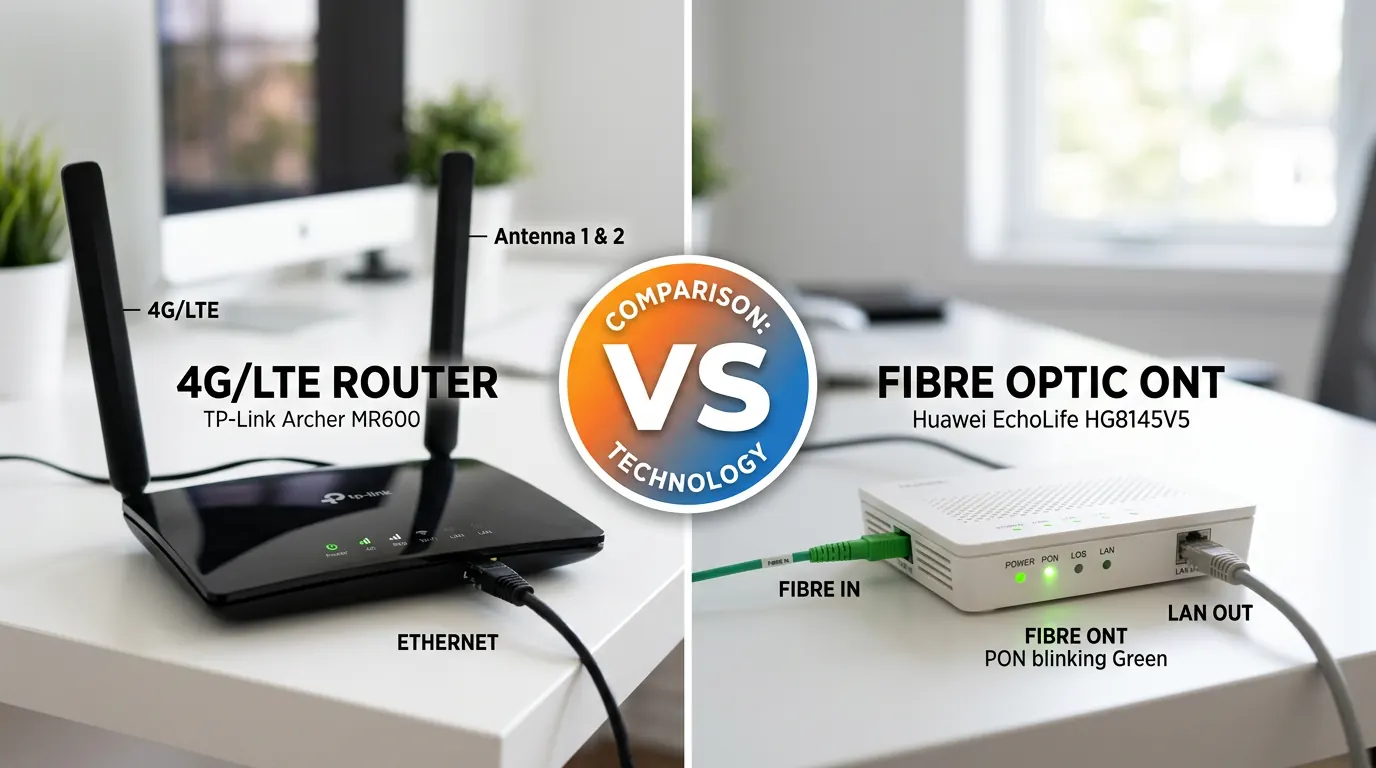
Fibre is the gold standard for business internet where it’s available: fast, stable, and scalable. But fibre isn’t in every street yet, and some businesses are in areas where LTE (or similar wireless) is the practical option. LTE has improved a lot — higher speeds, better latency, and fixed-LTE offerings that act like a primary line.
This article compares LTE and fibre so you can choose the right connection for your business.
Speed and latency
Fibre typically offers higher and more consistent speeds — from tens of Mbps up to 1 Gbps — with low, stable latency. LTE can reach similar peak speeds in good conditions (e.g. 50–100 Mbps or more on 4G/5G), but speed and latency vary with signal strength, congestion, and distance from the tower. For video calls, cloud apps, and most office use, a good LTE connection can be sufficient; for heavy uploads, servers, or real-time applications, fibre is usually better.
Reliability and congestion
Fibre is a dedicated line to your premises — not shared with the neighbourhood in the same way as wireless. LTE is shared spectrum: at busy times, speeds can drop. Weather and obstructions can also affect wireless. Fibre is generally more predictable; LTE can be very reliable in areas with strong coverage and uncongested towers.
Availability and installation
Fibre is only available where an FNO has rolled out in your street. LTE works wherever there’s mobile coverage — so it’s often the only option in rural or newly developed areas. Fibre usually requires a physical installation (often free or subsidised); LTE needs a router and sometimes an antenna. Installation time for LTE can be shorter.
Cost
Fibre pricing is often competitive for the speed you get, especially in well-served areas. LTE can be cheaper in some cases but may have lower or more variable speeds and sometimes data caps. Fixed LTE business packages may include higher data allowances and better support. Compare total cost (setup, monthly, and any data top-ups) for your usage.
When to choose fibre vs LTE
Choose fibre when it’s available and your business depends on stable, fast internet: offices, cloud-heavy workflows, video calls, or hosting. Choose LTE when fibre isn’t at your address, you’re in a temporary or remote location, or you need a backup line. Some businesses use both: fibre as primary and LTE as failover. Need help deciding or setting up? View our internet services or contact us.
Frequently asked questions
Can LTE replace fibre for a small business?
In areas without fibre, yes — a good fixed LTE connection can be the primary line. Where fibre is available, fibre is usually the better primary choice for reliability and speed; LTE can still be a useful backup.
Is LTE affected by weather?
Heavy rain or storms can sometimes affect wireless signals; fibre is largely unaffected by weather. In practice, modern LTE is robust for most conditions. If you’re in an area with frequent outages, consider a backup connection.
What is fixed LTE?
Fixed LTE is a dedicated LTE connection for your premises (router, often an antenna) used as your main internet line — as opposed to mobile LTE on a phone or dongle. It’s more stable and often has higher data allowances than typical mobile plans.
Fibre wins on speed and stability where it’s available; LTE is the practical choice where it isn’t, or as a backup. Compare availability, cost, and your actual usage to decide. Need business internet or a backup connection? View our internet services or get in touch.