
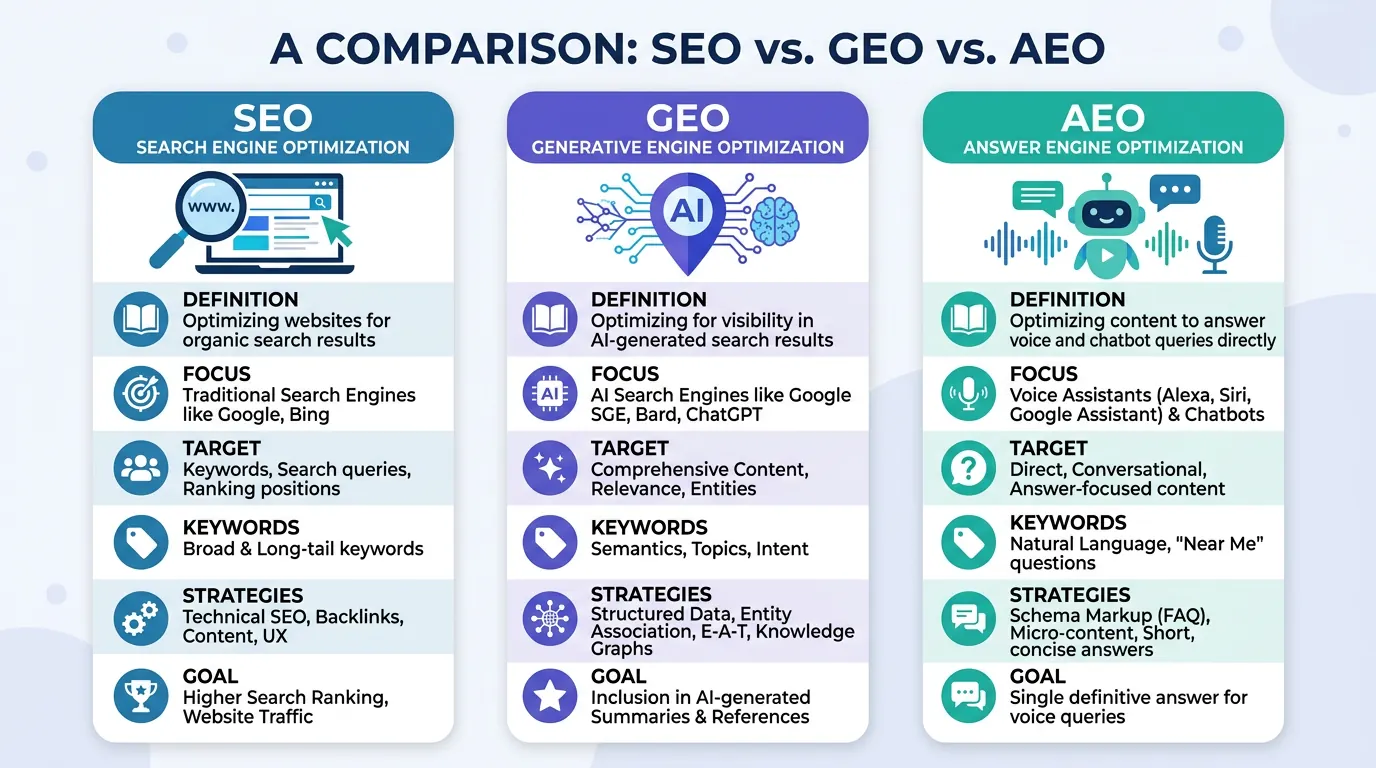
Search is no longer only “ten blue links.” Google shows featured snippets, voice answers, and generative summaries; other tools answer questions in chat. That’s led to new acronyms: GEO (Generative Engine Optimisation) and AEO (Answer Engine Optimisation) alongside classic SEO. Understanding the difference helps you decide where to focus.
This article explains what each one is and how they fit together for a small business.
SEO: traditional search engine optimisation
SEO is about ranking in standard search results. You optimise titles, content, links, and technical setup so Google (and other search engines) understand and favour your pages. The goal is to appear in the organic list when someone searches. SEO is still the foundation: if your site isn’t findable in normal search, the rest is harder. For most businesses in South Africa, solid SEO — clear content, good structure, local signals — remains the priority.
AEO: answer engine optimisation
AEO focuses on being the source for direct answers: featured snippets (the box above the results), “People Also Ask,” and voice answers. You structure content so it can be quoted or read aloud as the answer. That means clear headings, concise paragraphs, and answering questions directly. AEO is an extension of SEO: same content, optimised for how engines extract and present answers. Many of the same practices (good headings, FAQs, clear definitions) help both ranking and answer boxes.
GEO: generative engine optimisation
GEO refers to optimising for machine-generated answers — e.g. Google’s generative summaries, ChatGPT, or Copilot. These tools summarise the web rather than listing links. GEO is about being cited or paraphrased in those summaries. Tactics are still evolving: authoritative, well-structured content and clear expertise help. For most small businesses, GEO is secondary: focus on SEO and AEO first, and your content is more likely to be reused by assistant-style tools too.
Which one should you focus on?
Start with SEO: get your site indexed, your keywords right, and your local presence (e.g. Google Business Profile) in order. Then layer in AEO: structure key pages with clear answers and FAQs so you have a chance at snippets and voice. GEO is worth being aware of, but you don’t need a separate strategy yet — good, clear content benefits all three. If you’d like help with SEO and content strategy, our digital marketing services include SEO and local optimisation.
Frequently asked questions
Will generative search replace Google results?
Search results are changing: machine-generated summaries and answer boxes sit alongside traditional links. For now, traditional search is still where most clicks happen for many queries. Optimising for both standard results and direct answers (SEO + AEO) covers the bases.
Do I need to do something special for voice search?
Voice search often uses the same answers as featured snippets — concise, natural-language answers. So AEO-style content (clear questions and answers, FAQs) helps voice as well. You don’t need a completely separate “voice” strategy.
Is GEO relevant for small businesses in South Africa?
GEO is still emerging. For most small businesses, investing in solid SEO and clear, answer-friendly content (AEO) is the best use of time. As generative search becomes more prominent, that same quality content is what GEO will tend to favour.
SEO, AEO, and GEO are related: strong SEO is the base; AEO helps you capture direct answers and voice; GEO is about being used by generative engines. Focus on SEO and AEO first. Need a hand with strategy or implementation? View our digital marketing services or contact us.